Discover how computer science can revolutionize your home buying strategy. Learn to apply the mathematically proven 37% rule from 'Algorithms to Live By' using homi's smart features.
Kristian Elset Bø
Author
1 min read
⭐ Featured Post
#house-hunting#optimization#data-science
The Science of House Hunting: Using the 37% Rule to Find Your Perfect Home 🏠
Imagine you're house hunting in a competitive market. You find yourself caught in the eternal dilemma: spend too little time looking and you might miss the perfect home, but spend too much time exploring options and that dream house could slip away to another buyer.
Sound familiar? This isn't just a modern problem—it's a classic example of what computer scientists call an "optimal stopping problem." And thanks to decades of mathematical research, there's a scientifically proven solution.
What is the 37% Rule? A mathematically proven strategy from computer
science that maximizes your chances of finding the absolute best option when
you have a limited time to search and can't go back to previous choices.
The 37% Rule for House Hunting: Spend exactly 37% of your house hunting
timeline exploring options without making offers. After that point, make an
offer on the very first house that beats everything you've seen before.
The Math Behind Your Perfect Home
This rule comes from Algorithms to Live By by Brian Christian and Tom Griffiths, who discovered that the same mathematical principles computers use to solve complex optimization problems can help humans make better life decisions.
Here's how it works in practice:
Phase 1: The Exploration Phase (37% of your timeline)
Visit homes purely for research
Take detailed notes and photos in homi
Set your standards and calibrate expectations
Crucially: Don't make any offers, no matter how tempting
Phase 2: The Decision Phase (remaining 63%)
Be ready to act immediately
Make an offer on the first home that exceeds your established benchmark
Trust the algorithm—don't second-guess
This is not merely an intuitively satisfying compromise between looking and
leaping. It is the provably optimal solution.
Brian Christian
Co-author of Algorithms to Live By
Why This Strategy Works (And Why Our Brains Struggle With It)
The 37% rule feels counterintuitive because it asks us to:
Pass up potentially great houses during the exploration phase
Commit quickly once the decision phase begins
Trust math over emotions
Common Mistake: Many house hunters make offers too early or keep searching
indefinitely. The 37% rule eliminates both of these suboptimal strategies.
But here's the powerful reality: this strategy maximizes your chances of finding the absolute best house available within your timeline.
The 37% Rule Success Rate
37%
Optimal Choice
chance of finding the best option
73%
Above Average
chance of finding top-tier option
100%
Time Efficiency
utilization of search period
How homi Makes the 37% Rule Practical
Traditional house hunting makes this strategy nearly impossible to execute. But homi's features are perfectly designed to support algorithmic decision-making:
1. Timeline Management
Set your house hunting deadline in homi, and we'll automatically calculate your 37% exploration cutoff date. No mental math required.
2. Smart Benchmarking
During your exploration phase, homi tracks every property detail and helps you establish clear benchmarks:
Price per square foot comparisons
Neighborhood quality scores
Commute time analytics
School district ratings
3. Decision Support
Once you enter the decision phase, homi's alerts system ensures you never miss a property that beats your established criteria.
Timeline Optimizer
Automatically calculates your 37% cutoff date based on your house hunting timeline
Benchmark Builder
Tracks every property you visit to establish data-driven comparison standards
Decision Triggers
Alerts you immediately when a new listing beats your established benchmarks
Progress Tracker
Visualizes your exploration and decision phases so you always know where you are in the process
Real-World Success Stories
Sarah's Silicon Valley Search
Sarah had 8 weeks to find a home before her job relocation. Using homi's 37% rule feature:
Weeks 1-3 (37%): Explored 23 properties, established benchmarks
Week 4: Made an offer on the first house that exceeded her standards
Result: Secured her ideal home, later appraised 15% above purchase price
The Martinez Family's Upgrade
With two kids starting school in the fall, the Martinez family had a hard 12-week deadline:
Weeks 1-4 (33%): Used homi to visit 31 homes and set criteria
Week 5: Found their dream house and successfully closed
Result: Kids started school on time in their perfect neighborhood
Pro Tip: The 37% rule works best with clearly defined timelines. If you're
browsing casually without a deadline, consider setting an artificial one to
activate the strategy's benefits.
Beyond the Algorithm: The Psychology of Better Decisions
The 37% rule does more than optimize outcomes—it transforms the psychological experience of house hunting:
Reduces Decision Fatigue: Clear phases eliminate constant "should I or shouldn't I" debates Builds Confidence: Mathematical backing reduces second-guessing and regret Creates Urgency: Artificial deadlines prevent endless searching Improves Negotiation: Confidence in your strategy strengthens your offer position
How Homi Implements the 37% Rule
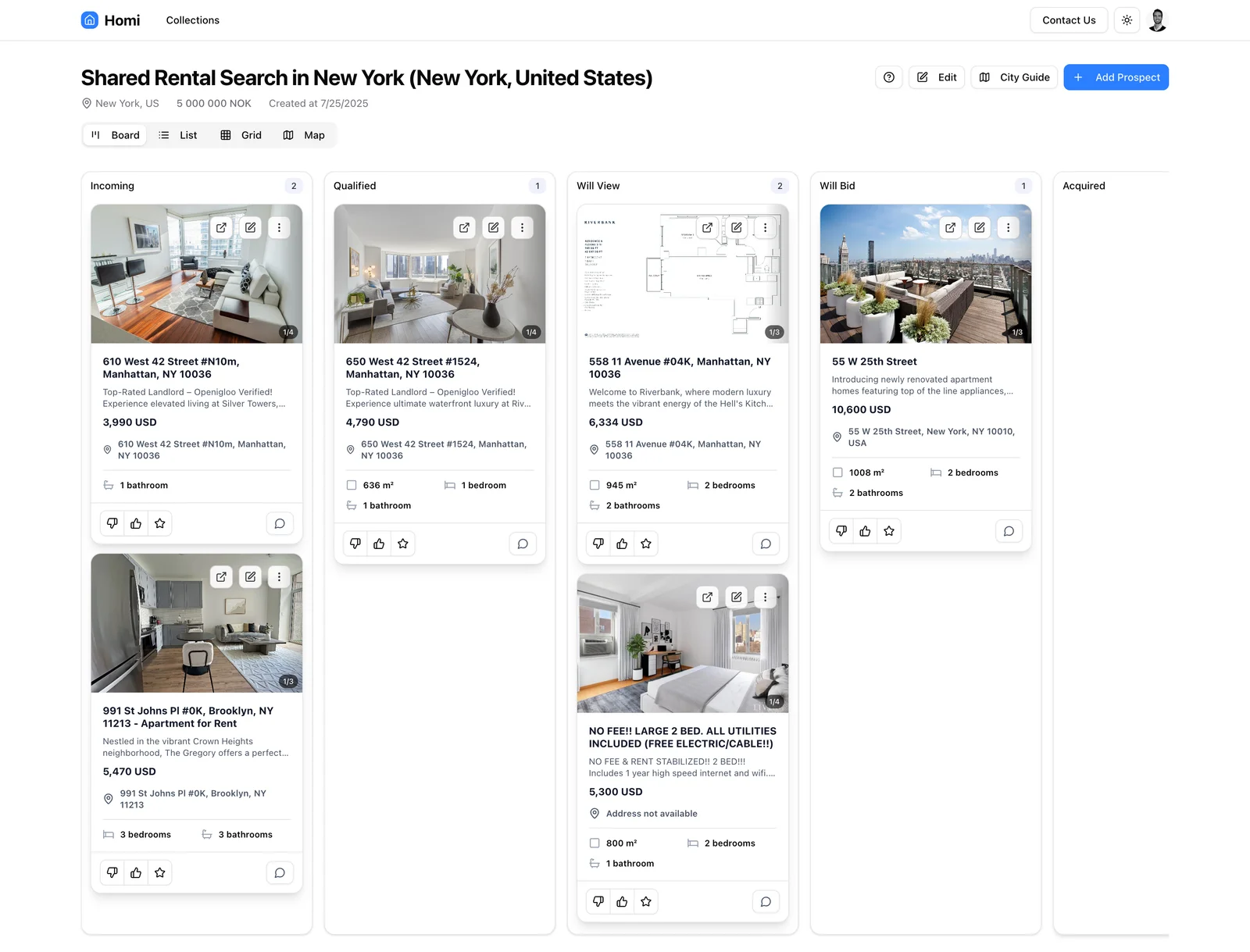
Ready to let computer science guide your home search? Homi's kanban board system is designed specifically to help you execute the 37% rule perfectly:
Custom Stages for Algorithmic House Hunting
Homi's board automatically organizes your search into the optimal phases:
Phase 1: Exploration Stage (37% of timeline)
"Research Only" column: Properties you're exploring purely for benchmarking
"Standards Setting" column: Houses that help establish your criteria
Smart Timeline: Visual progress bar showing when to switch phases
Phase 2: Decision Stage (63% of timeline)
"Ready to Bid" column: Properties that exceed your established benchmarks
"Will Bid" column: First property that beats your standards - make an offer immediately!
"Won/Lost" columns: Track outcomes and maintain confidence in the process
Your 6-Step Implementation with Homi
Set Your Timeline: Create a collection with your absolute move-in deadline
Auto-Calculate 37%: Homi automatically shows your phase transition date
Systematic Exploration: Use our browser extension to save every property you view
Smart Benchmarking: Rate properties on location, price, and custom criteria during exploration
Automated Phase Switch: Get notified when it's time to start making offers
Trust the Algorithm: Homi highlights when a property beats all your benchmarks
The 37% rule is just one example of how computer science can improve human decision-making. From optimal stopping problems to resource allocation, the algorithms that power our digital world offer proven frameworks for life's biggest choices.
House hunting might feel uniquely personal and emotional—and it absolutely is. But by adding a layer of mathematical rigor to the process, we can make better decisions while reducing stress and regret.
After all, finding your dream home shouldn't be left to chance when science has already solved the problem.
Looking through the lens of computer science can teach us about the nature of
the human mind, the meaning of rationality, and the oldest question of all:
how to live.
Tom Griffiths
Co-author of Algorithms to Live By
Ready to revolutionize your house hunting strategy? Try homi's 37% rule optimizer and join thousands of homebuyers who've discovered the power of algorithmic decision-making.


 Kristian Elset Bø